Engineering Journal
Case Study: QR + Geofenced Security Patrol App for MES Blue Printing

Context
During MES blue printing for a manufacturing campus, we audited support operations outside the production line. One critical process was the night security patrol around the building perimeter.
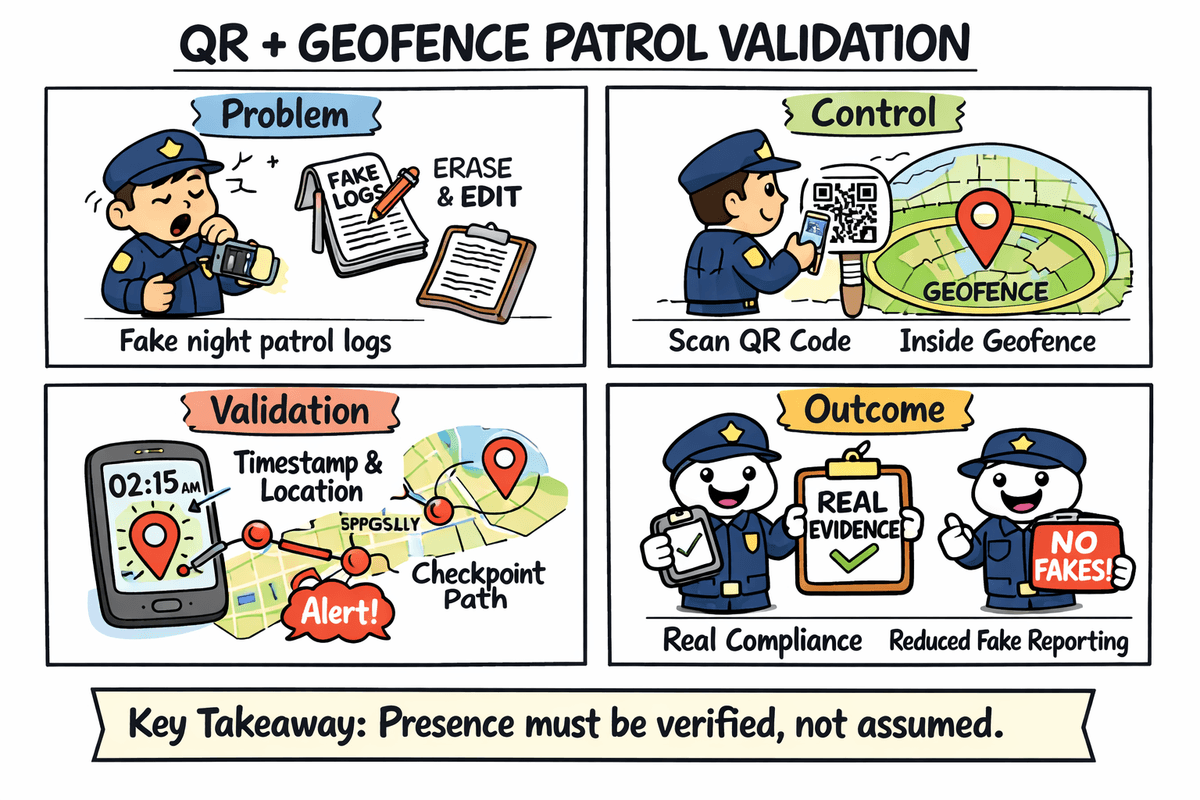
The expected process was simple:
- Security staff must patrol fixed checkpoints during each shift.
- Every checkpoint visit must be recorded in a patrol log.
But in reality, we found a control gap: entries were often filled in the physical logbook even when patrol routes were not actually completed.
Problem
The paper logbook process had no reliable verification mechanism.
- A guard could mark "patrolled" without physically visiting each point.
- Supervisors had no timestamped and location-verified evidence.
- Incident review had weak traceability.
For plant leadership, this created a risk in safety, compliance, and audit readiness.
Objective
Create a patrol recording system where an entry is accepted only if the guard is physically present at the approved checkpoint location.
Solution
We developed a mobile patrol app with two controls enforced together:
1. QR Checkpoint Validation
- Unique QR codes were installed at multiple building-wall checkpoints.
- Guard must scan the checkpoint QR code during patrol.
- Each scan identifies the exact patrol point in the route sequence.
2. Geofence Coordinate Validation
- We mapped and stored geofence coordinates for every checkpoint.
- At scan time, the app validates the guard device GPS against that checkpoint geofence.
- If device location is outside allowed radius, the patrol record is rejected.
This design removed the old loophole where someone could fill entries remotely.
Digital Patrol Flow
- Guard opens patrol app and starts assigned round.
- Guard reaches checkpoint and scans QR code.
- App fetches current GPS and compares with checkpoint geofence.
- If within radius, app records a verified patrol event.
- Event is stored with guard ID, checkpoint ID, timestamp, coordinates, and shift context.
- Supervisor dashboard shows completion status and missed points in real time.
Why This Was Effective
The key was combining two independent proofs:
- What point was scanned (QR identity)
- Where the scan happened (geofence match)
A valid patrol record needed both. This made fake completion practically impossible in normal operations.
Operational Outcomes
- Replaced manual logbook dependency with verified digital records.
- Eliminated false-positive patrol completion entries.
- Improved shift-level accountability for security teams.
- Enabled audit-ready patrol history with location and timestamp evidence.
- Increased trust in non-production operational controls during MES rollout.
Architecture Snapshot
- Mobile app for guards (checkpoint scanning workflow)
- Patrol validation service (QR + geofence rules)
- Central event store for patrol logs
- Supervisor view for compliance monitoring and exceptions
MES Blue Printing Lesson
MES transformation is not only about machines and production transactions. Supporting controls such as physical security rounds also need digital truth.
When such controls stay manual, they become weak links. When they are verified at source, the entire operational governance model becomes stronger.