Engineering Journal
Case Study: Rule-Based Material Allocation Engine for Multi-Factory Manufacturing

Business Context
In make-to-order manufacturing, material allocation mistakes directly create production delay, planning instability, and buyer-level commitment risk.
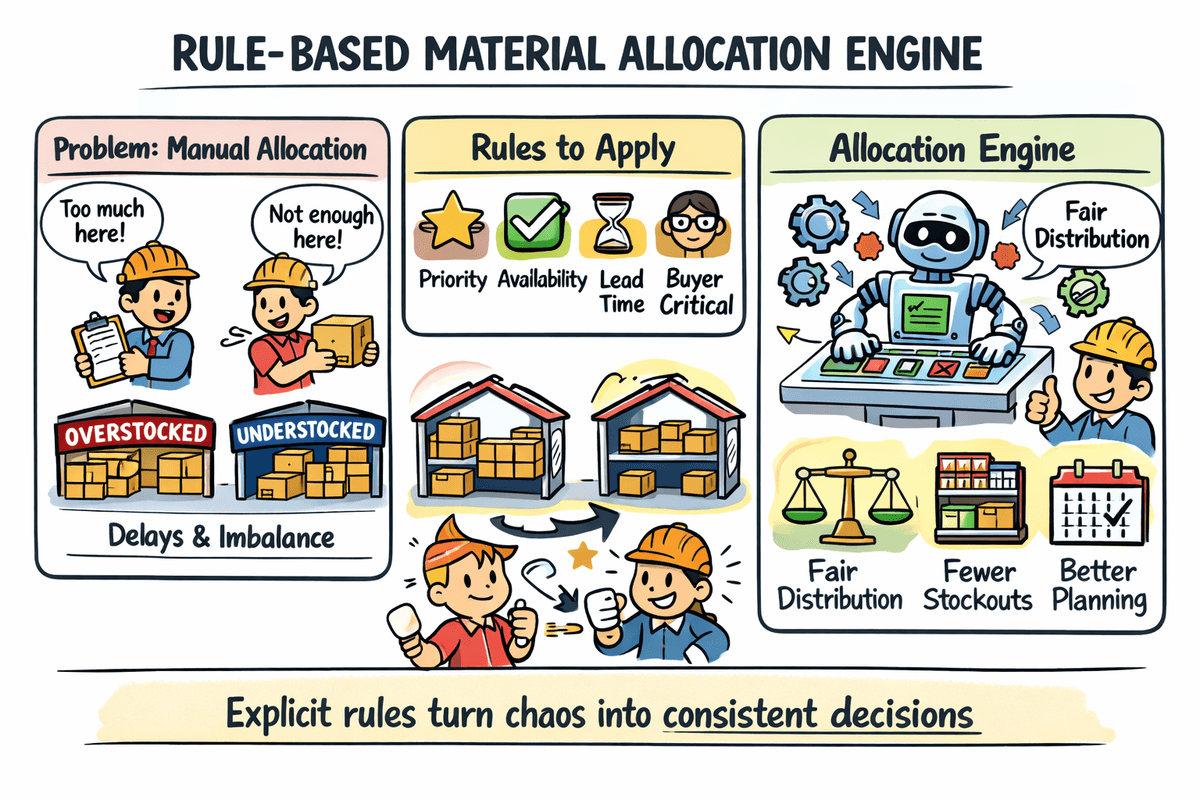
Our environment required buyer PO-aware control, lot-level traceability, and support for multi-factory execution.
Core Problem
Operational teams needed both speed and control:
- Production expected quick material confirmation.
- Warehouse required governed allocation logic.
- Planning faced frequent date changes and cancellation scenarios.
- Manual priority calls created inconsistency and audit pain.
Strategy
We designed a rule-based allocation framework with clear ownership:
- MES creates and tracks material request intent.
- WMS remains inventory source of truth.
- Allocation is controlled by policy with deterministic request identity.
System Design
Request lifecycle
- MES logs request intent.
- Async job triggers WMS GET request creation using stable reference IDs.
- Request status is tracked explicitly across creation, allocation, and dispatch states.
Allocation model
- Default FIFO suggestion supported.
- Lot-level checks supported when required.
- Same-buyer and same-lot validations exposed as configurable policies.
Governance flows
- PO-to-PO transfer supported with approvals for cancellation/date-change scenarios.
- Allocation and movement actions recorded with clear lineage.
Implementation Challenges
- Concurrent requests from multiple lines competed for limited RM.
- Operational flexibility was needed without losing rule consistency.
- Retry and timeout scenarios demanded dedupe-safe integration behavior.
Impact
- Reduced allocation ambiguity across planning, production, and warehouse teams.
- Improved traceability from request intent to dispatch outcome.
- Enabled policy-driven behavior instead of ad-hoc coordination.
- Created a reusable architecture pattern for future plants and workflows.
Strategic Lesson
The biggest gain was not only automation. It was moving allocation decisions from person-dependent behavior to controlled policy execution with auditable outcomes.
Executive Snapshot
Material allocation scales only when request intent, warehouse authority, and policy checks are separated and traceable.
Allocation Clarity
ImprovedRequest states made ownership explicit across MES and WMS teams.Traceability
Lot + PO AwareLineage from request to movement reduced audit friction.Policy Compliance
HigherFIFO defaults and approval-based overrides balanced speed with control.Intent Capture
MES request lifecycle
Material intent was tracked independently from physical stock movement.
Policy-Based Allocation
WMS rule authority
FIFO, lot checks, and buyer constraints were executed as controlled policies.
Governance Workflows
Exceptional cases
PO-to-PO transfers and date-change scenarios were handled with explicit approvals.