Engineering Journal
Case Study: Parikshit Audit-Proof Question Paper Platform with Dual-Control Access

Context
Parikshit, a government question paper preparation platform, was handed over to us in a partially implemented state with weak baseline controls. The existing build had beginner-level shortcuts and was not audit-safe for high-sensitivity exam workflows.
The system needed to support multilingual question content (Telugu, Hindi, Tamil, and other Indian languages), strict secrecy, and controlled release.
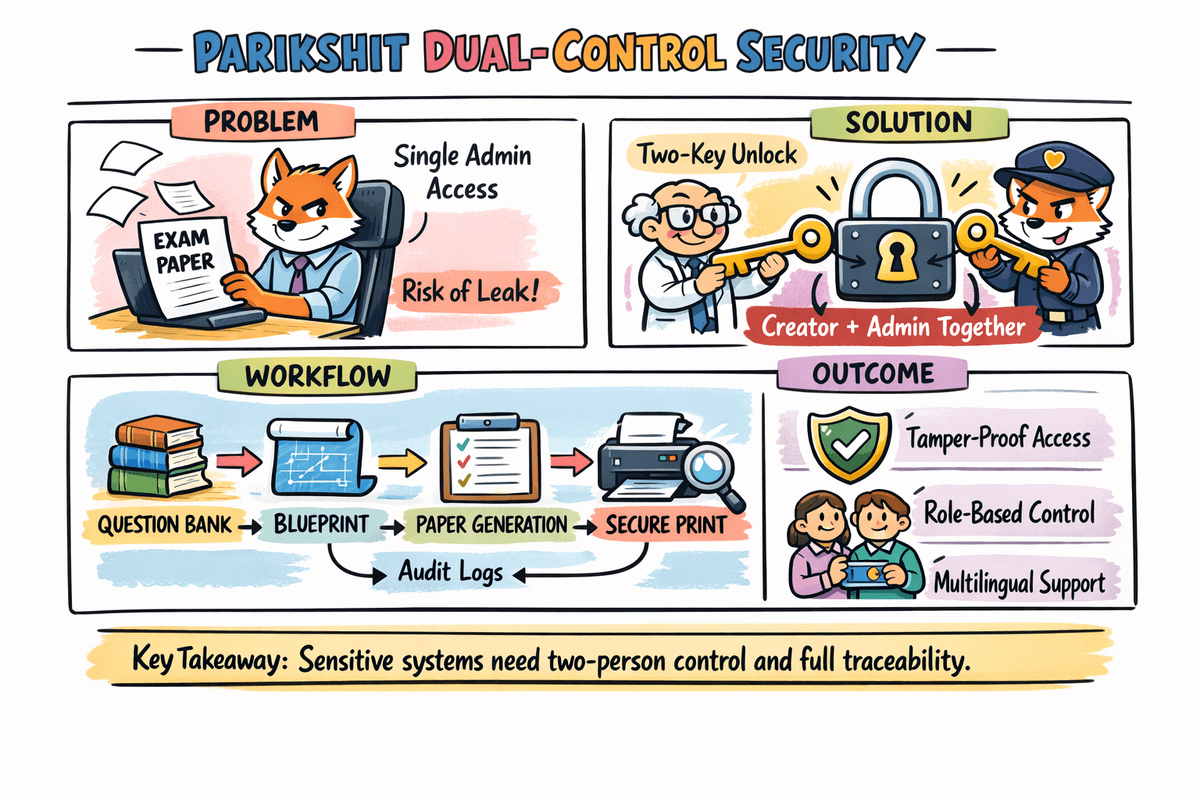
Product Scope Confirmed from Documents
From the provided overview and user manual, the platform scope includes:
- Question Bank Management: subject, chapter, questions, difficulty, taxonomy, marks
- Blueprint Creation: blueprint name, section, mandatory questions, marks, difficulty level, taxonomy selection
- Paper Generation: AI-assisted and manual paper preparation paths
- Secure Paper Print: print format, preview, secret code generation per paper, and final secure print output
The user manual also defines operational roles and permissions such as Super Admin, Question Bank Editor, and Paper Setter, with subject-wise access boundaries.
Initial Risk Areas
During takeover and assessment, we identified multiple governance and security concerns:
- Inconsistent protection model for stored question content
- Weak operational controls for paper visibility and release
- Limited accountability across user actions
- Incomplete separation of duties
- Deployment model not suitable for controlled, isolated operations
Objective
Redesign and harden the platform so that it becomes:
- audit-proof,
- operationally robust,
- deployment-isolated per institution,
- and secure against single-user compromise.
What We Implemented
1. Dual-Control Paper Reveal (Two-Person Rule)
The most important control was implementing dual authorization for viewing question papers.
A paper is visible only when both credentials are provided:
- credential 1: paper creator secret/password
- credential 2: Parikshit admin secret/password
This enforces separation of duties and prevents unilateral access.
2. Self-Hosted Isolation per Individual Setup
We deployed the platform in controlled self-hosted environments at individual institution level.
- Reduced shared blast radius
- Better ownership and local governance
- Easier compliance mapping per deployment
3. Multilingual-Safe Content Handling
Question content across Indian languages was preserved reliably by enforcing UTF-8-safe processing and validation across input, storage, and retrieval layers.
This prevented corruption or loss of non-Latin text during workflows.
4. Security Hardening for Storage and Access
We replaced weak obfuscation patterns with robust security controls aligned to audit expectations:
- protected storage strategy for sensitive question content
- strict access boundaries and role-aware workflows
- authenticated and traceable reveal actions
We also hardened authentication and profile workflows documented in the manual:
- secure login with failed-attempt monitoring
- role-routed dashboard access post-login
- admin-controlled user creation with subject-level assignment
- password masking/visibility controls and credential governance
5. Audit-Ready Operational Traceability
Critical actions were made auditable so the system can provide investigation-grade evidence:
- who performed an action,
- when action occurred,
- what stage was affected,
- and which approval path allowed access.
Why Dual-Control Changed the Game
In high-risk exam systems, single-credential access is a governance failure waiting to happen.
By requiring two independent approvals before reveal, we introduced a strong procedural + technical lock that removed the most dangerous single-point access pattern.
Outcomes
- Platform moved from fragile implementation to audit-ready system design.
- Question paper visibility now requires dual authorization, not individual discretion.
- Security posture improved without breaking operational usability.
- Self-hosted model improved control and deployment governance.
- Stakeholders gained higher trust in confidentiality and release workflow integrity.
Architecture Lesson
For government-grade systems, security is not one feature. It is a layered control model:
- strong data protection,
- role separation,
- dual authorization,
- and complete audit traceability.
When these controls are designed together, the platform becomes resilient against both technical and process-level failures.