Engineering Journal
Case Study: Work Order Flow System That Reduced Buyer-to-Mill Delays

Business Context
In apparel manufacturing execution, delays often start much earlier than production.
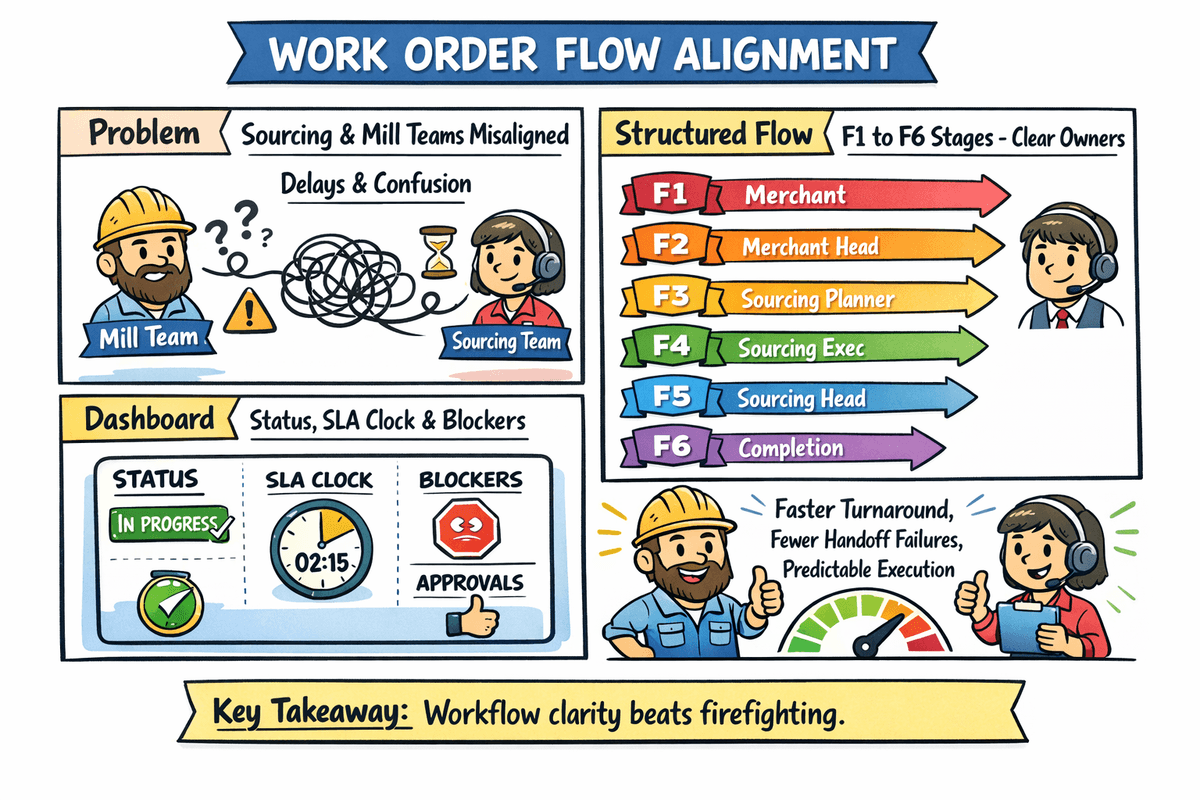
The most critical handoff chain is:
- Buyer request and sampling inputs
- Merchandising coordination
- Sourcing decisions
- Mill execution (in-house or third-party)
Before our implementation, these steps were distributed across spreadsheets, emails, and department-specific trackers, causing cycle-time loss and status ambiguity.
Core Problem We Solved
The organization needed one controlled workflow for the full Work Order lifecycle. Without it, teams faced:
- Delays between merchandising and sourcing handoffs
- Inconsistent status visibility across departments
- Revision confusion and outdated versions in circulation
- Repeated follow-up calls/emails for basic status checks
- Fragmented records during buyer change requests
Objective
Build a single Work Order flow system that captures the full journey from initial buyer order to final work order execution, while supporting revisions and auditable communication between all departments.
Scope We Designed
The flow covered all major stages:
- Initial buyer order intake
- Sampling process orchestration
- Bulk confirmation and proposal creation
- Composition and RM item finalization
- Indent creation
- Work Order creation
- Revision handling and version control
- Revised version circulation and email communication
Process Blueprint Artifacts
To align business and engineering, we created structured flow artifacts and dashboards, including:
- Simple Work Order flow maps
- Work Order status transition definitions
- Work Order sharing, allocation, and conversion logic
- Category-wise Work Order flow charts (including popup decision points)
- Work Order body block format and block placement standards
- Merchant and Merchant Head dashboard definitions
These artifacts allowed the system to be implemented with role clarity and predictable transitions.
Solution Architecture
1. Lifecycle-Based Work Order Engine
We modeled Work Order as a state machine with deterministic transitions instead of free-form status updates.
- Each step had entry/exit conditions.
- Role-based permissions controlled who could move what.
- Transition logs made movement auditable.
2. Category-Aware Workflow Paths
Different Work Order categories required different sub-flows and popup-based validations.
- Category-specific checks were embedded in workflow logic.
- Users saw only relevant decision blocks for their category.
- Reduced manual interpretation errors.
3. Revision and Version Governance
Revision handling was treated as a first-class process, not a side note.
- Every revision generated a controlled version update.
- Previous versions remained traceable.
- Revised Work Orders were circulated through structured communication.
This prevented parallel work on obsolete versions.
4. Structured Inter-Department Communication
Instead of ad-hoc message chains, the system coordinated communication events between merchandising, sourcing, and mills.
- Email communication was tied to workflow events.
- Stakeholders received context-aware updates.
- Escalation paths became predictable.
5. Merchant and Merchant Head Visibility
We implemented dashboard views for commercial and management roles.
- Pending actions by stage and owner
- Revision counts and aging indicators
- Allocation/conversion progress snapshots
- Exception and delay hotspots
Outcomes
The system significantly improved execution discipline and reduced handoff delays:
- Faster movement from buyer initiation to executable Work Orders
- Better synchronization between merchandising, sourcing, and mills
- Lower confusion during revision-heavy cycles
- Stronger status transparency for merchant leadership
- Reduced dependency on manual follow-ups and fragmented emails
Why This Matters
In buyer-driven manufacturing operations, delay is usually a workflow design issue before it becomes a production issue.
By digitizing Work Order lifecycle logic end-to-end, we transformed a coordination-heavy process into a controlled, measurable system that teams could trust.
Leadership Insight
Good workflow software is not just screens and forms. It is policy made executable.
When policy, roles, and transitions are encoded correctly, cross-functional operations accelerate without losing governance.