Engineering Journal
Case Study: Automotive Service R&D Using Odometer Signals, Telemetry Tracking, and WhatsApp Workflows

Context
This initiative was developed as a product R&D framework for automotive service-center operations, intended to support future engagements across multiple customers.
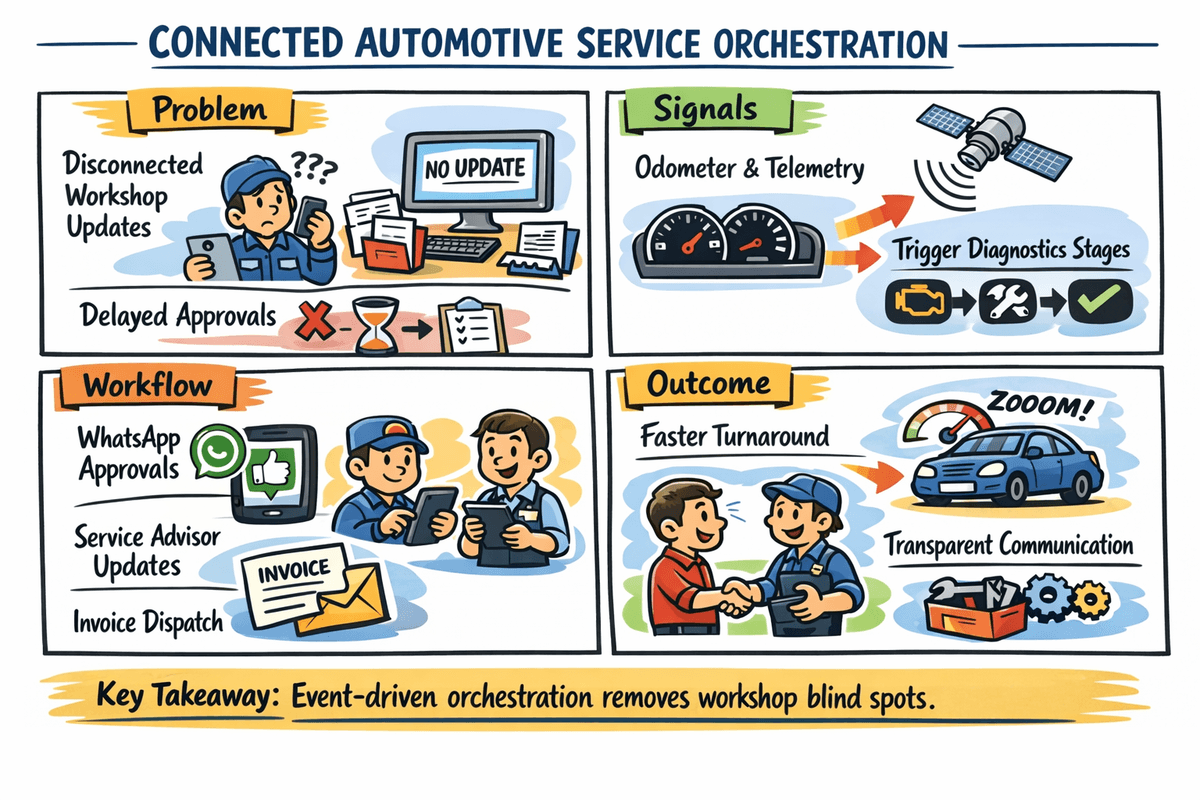
Instead of treating servicing as isolated job cards, we designed an event-driven workflow from vehicle check-in to final invoice and customer feedback.
Current Status
This solution is currently kept in R&D / pilot-ready phase and has been designed so it can be adapted when onboarding additional service-center customers.
- Core architecture and workflow logic are validated.
- Integration points are modular for customer-specific adaptation.
- Rollout model is engagement-based, not single-client hardcoded.
Problem We Targeted
Typical service centers suffer from fragmented process control:
- Vehicle issue discovery is inconsistent during test drive.
- Additional issues (beyond customer complaint) are poorly communicated.
- Service-stage visibility is weak for both customer and owner.
- Invoice and feedback loops are manually delayed.
Objective
Build an integrated service lifecycle where:
- diagnostic inputs start from odometer/test-drive context,
- customer approvals happen through WhatsApp forms,
- vehicle movement/status is tracked in near real time,
- invoicing and feedback are digitally closed,
- and owners get a live dashboard for operational control.
Solution Architecture
1. Odometer-Linked Service Intake
At vehicle entry and test-drive stage, odometer readings are captured and linked to service context.
- Baseline vehicle state is established at intake.
- Test-drive observations are tied to vehicle mileage context.
- Helps detect additional problem patterns beyond initially reported issues.
2. WhatsApp Form-Based Approval for Additional Work
When technicians find issues not originally specified by the customer:
- a structured WhatsApp form is sent,
- customer selects which additional repairs/services to approve,
- approval trail is captured digitally.
This removes ambiguity and improves consent traceability.
3. Vehicle Step Tracking via Receiver Network
We designed a tracking model using receiver signals (RFID / Bluetooth / Wi-Fi, based on site capability) to monitor vehicle progression through service steps.
- Vehicle status is updated as it moves across defined checkpoints.
- Server receives event updates for workflow progression.
- Service desk and owner dashboard get live operational visibility.
4. Automated Service Closure
At end of service lifecycle:
- digital invoice is triggered to customer,
- WhatsApp feedback form is sent,
- service completion and customer response are captured in one flow.
Dashboard for Service Garage Owner
Owner-level dashboard was designed to expose actionable metrics:
- vehicles by current service stage,
- pending approvals,
- average turnaround indicators,
- closure and feedback status,
- bottleneck zones in service workflow.
Why This Matters
The architecture converts garage operations from manually coordinated tasks into an orchestrated digital flow with customer-in-the-loop decisions.
For multi-customer consulting, this R&D approach is valuable because the same framework can be configured per garage with minimal redesign.
Engagement Readiness
The framework is intentionally maintained in R&D/pilot mode so it can be quickly tailored for new customer environments:
- customizable checkpoint model,
- adaptable telemetry receiver strategy,
- configurable WhatsApp templates/forms,
- owner dashboard tuned by business size and workflow complexity.
Key Takeaway
Automotive service digitization works best when diagnostics, approvals, process tracking, billing, and feedback are connected in one event pipeline.
Building this as a reusable R&D framework enables faster, lower-risk onboarding for future customers.