Engineering Journal
Implementing Enterprise RBAC with Keycloak for ERP Workflows

As systems scale, authorization debt grows faster than code debt.
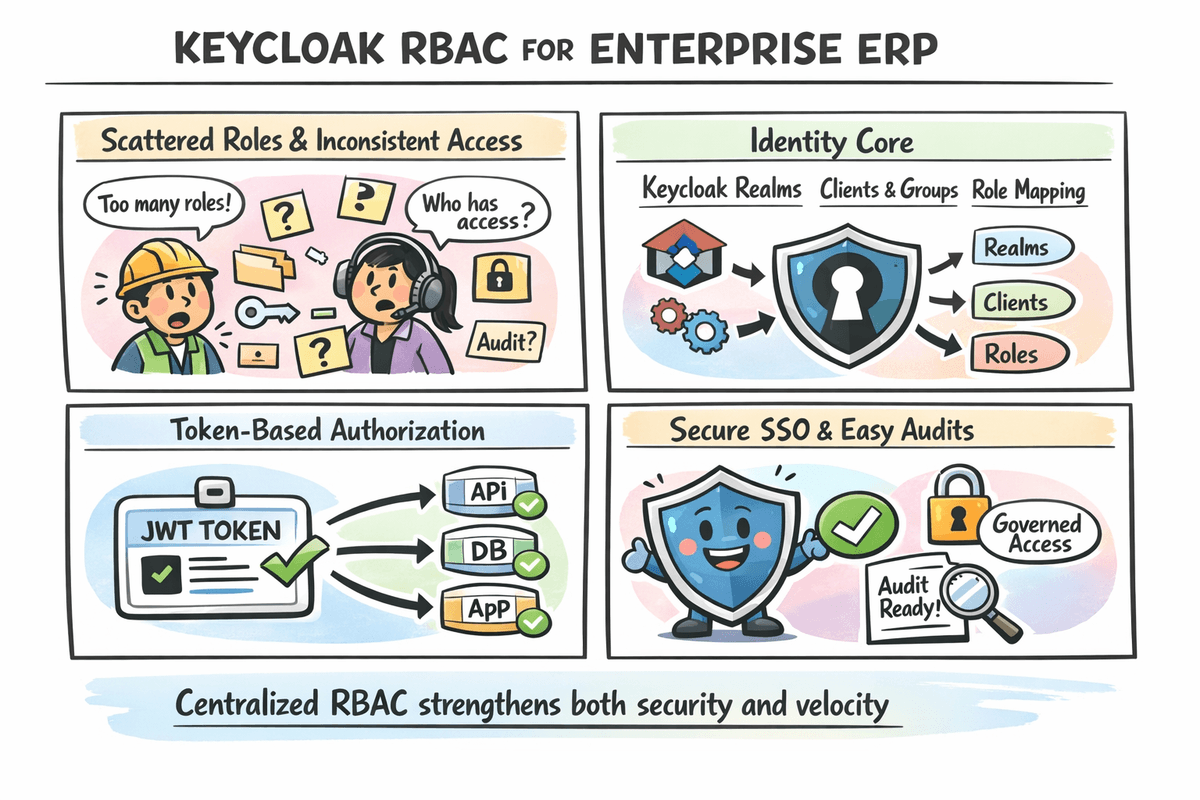
In enterprise operations, access control is not only security. It is also governance and accountability.
Starting Point
We had fragmented access control:
- Role checks were scattered across services.
- New module onboarding required custom logic each time.
- Audit teams struggled to answer who could do what.
Target Model
We adopted Keycloak as central IAM and defined an authorization strategy:
- Realm-level identity and authentication flows.
- Client-level roles mapped to business capabilities.
- Resource-level guards in APIs.
- Claims-to-permission mapping via middleware.
Practical Structure
Role design
We avoided giant roles like admin and used capability-based roles:
inventory.readinventory.adjustdispatch.approveworkorder.createiam.manage-users
Service integration
- APIs validated JWT claims and tenant context.
- Permission checks were consolidated into reusable guards.
- UI consumed permission metadata to hide unauthorized actions by default.
Auditability
- Access change events were logged with actor, action, scope, and timestamp.
- Sensitive endpoints carried stronger verification and explicit trace IDs.
Outcomes
- Faster onboarding for new modules due to reusable auth patterns.
- Better compliance posture with traceable permission changes.
- Lower risk from over-privileged user accounts.
- Fewer production issues caused by inconsistent role logic.
Advice for Teams Doing This Transition
- Standardize your permission naming convention early.
- Keep authorization decisions server-side, even if UI also checks permissions.
- Build role simulation tooling for testing workflows before release.
- Treat IAM rollout as product work, not only infrastructure work.
Executive Snapshot
Authorization maturity comes from capability-based role design and auditable policy enforcement, not from a single admin role.
Access Consistency
HigherReusable guards replaced scattered endpoint-level checks.Compliance Confidence
ImprovedPermission changes became traceable with actor and scope metadata.Module Onboarding
FasterStandardized roles reduced custom authorization logic per service.Authorization Baseline
Debt identification
Existing role checks were inventoried and normalized into capability-based permissions.
Central IAM Rollout
Keycloak integration
Realm and client role mapping were introduced with API-side claim enforcement.
Operational Governance
Audit and testing
Access change logging and role simulation workflows improved release confidence.