Engineering Journal
OEE for Software Engineers Working in Manufacturing

For years, I built manufacturing systems as an implementation engineer. The shift to architecture and strategy started when I learned to speak in KPI language, not only feature language.
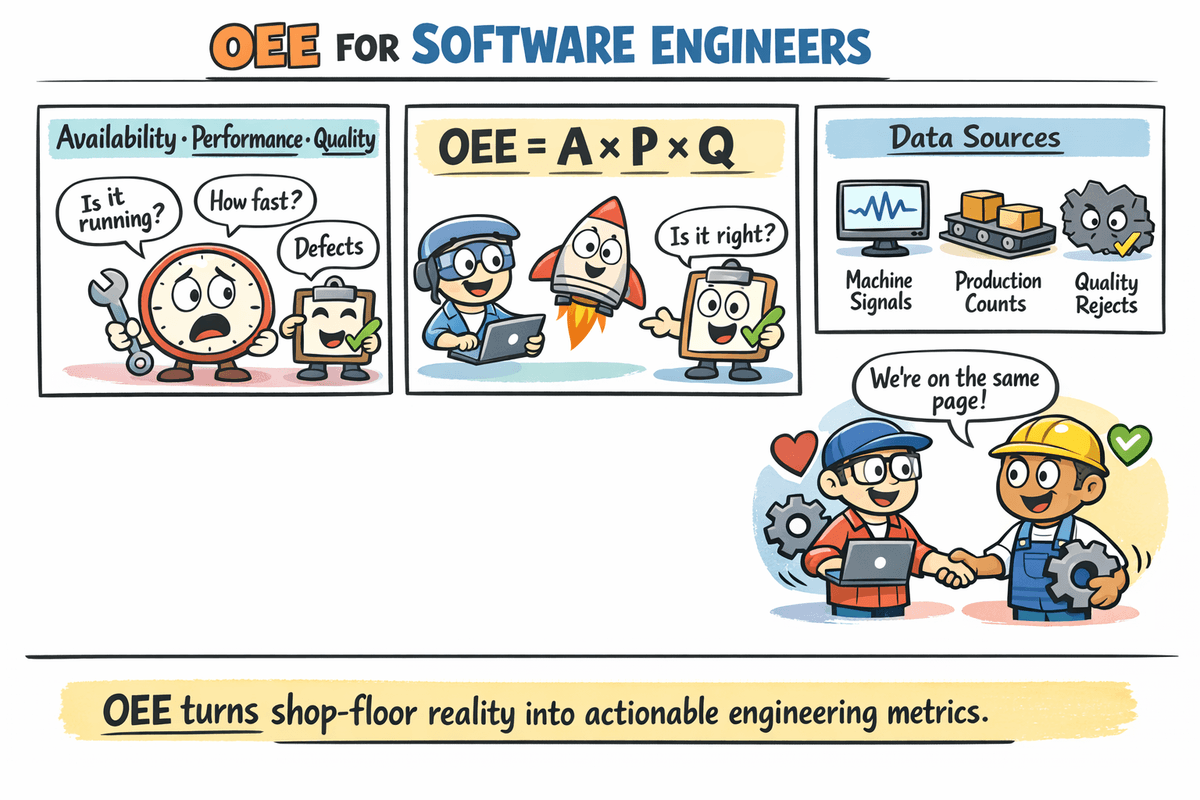
The first KPI every manufacturing systems engineer must master is OEE.
What OEE Means
OEE (Overall Equipment Effectiveness) is:
Availability x Performance x Quality
It tells you whether a line is truly productive, not just "running".
OEE Components
1. Availability
How much planned time was actually available for production.
Availability = Operating Time / Planned Production Time
Software impact:
- Downtime capture accuracy
- Breakdown categorization
- Escalation and maintenance workflows
2. Performance
How close actual output is to ideal speed.
Performance = (Ideal Cycle Time x Total Count) / Operating Time
Software impact:
- Real-time count tracking
- Bottleneck visibility
- Slow-cycle detection
3. Quality
How much output was good output.
Quality = Good Count / Total Count
Software impact:
- Defect capture workflow
- Rework tracking
- Lot and batch traceability
Why This Matters for Backend and Fullstack Engineers
When engineers say:
"We built downtime APIs and dashboards."
That sounds implementation-level.
When engineers say:
"We improved Availability visibility to support OEE improvement decisions."
That sounds architecture-level.
The second framing is what hiring managers at top industrial tech companies expect.
Practical Questions to Ask in Any MES Project
- Where can OEE be calculated reliably in this system?
- Is ideal cycle time available and trustworthy by machine or process?
- Are downtime reasons mandatory, structured, and auditable?
- Can we compute MTTR and MTBF from production data without manual cleanup?
- Can leadership trust this number for business decisions?
Leadership Takeaway
You do not become a manufacturing systems strategist by adding more endpoints. You become one by connecting software decisions to operational economics.
For me, learning OEE was the turning point from execution mindset to transformation mindset.
Executive Snapshot
OEE is where software quality, operational reliability, and business economics converge in one measurable framework.
Availability
Uptime IntegrityDepends on accurate downtime capture and structured cause taxonomy.Performance
Cycle EfficiencyRequires trusted ideal-cycle baselines and continuous bottleneck visibility.Quality
Good Output RatioDefect workflows and traceability determine decision confidence.Measurement Foundation
OEE data readiness
Systems must collect production, downtime, and defect data without manual cleanup.
Operational Transparency
Cross-team visibility
Dashboards align floor-level actions with leadership KPIs.
Strategic Optimization
Decision loop
OEE trends guide where engineering investment has the highest business return.