Engineering Journal
PLC and ISA-95 Basics for MES and Integration Architects

One of the biggest mistakes in manufacturing software is mixing responsibilities between ERP, MES, and WMS.
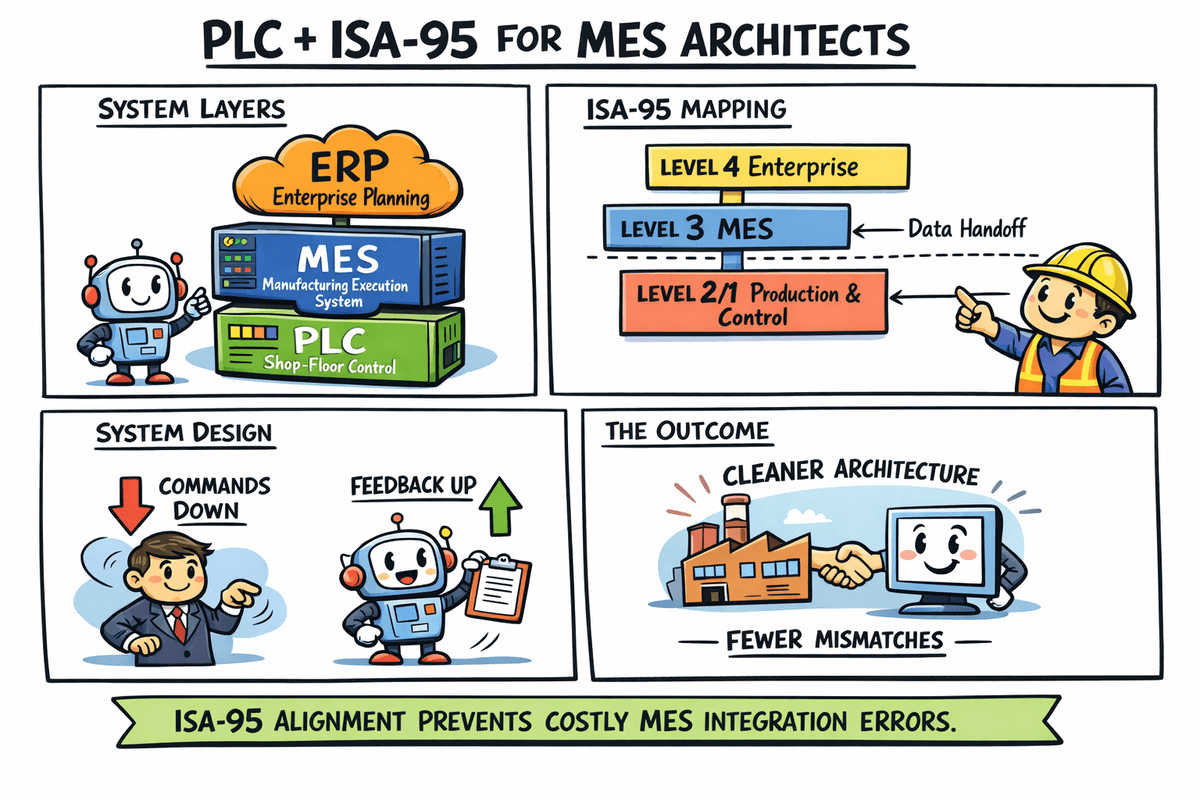
Industrial architecture gets clearer when you understand two things:
- What a PLC actually does
- How ISA-95 defines integration boundaries
What is a PLC?
PLC means Programmable Logic Controller.
It is the control layer close to machines and sensors. PLCs operate in milliseconds and are responsible for deterministic control behavior.
In most modern digital factories:
- PLC controls machine behavior
- MES controls execution workflow and tracking
- ERP controls enterprise planning and finance
ISA-95 in Simple Terms
ISA-95 provides a layered model for enterprise-control integration:
- Level 0: physical process
- Level 1: sensing and actuation
- Level 2: control systems (PLC/SCADA)
- Level 3: operations management (MES/WMS workflows)
- Level 4: business planning (ERP)
This model prevents ownership confusion.
Boundary Clarity That Works in Real Implementations
A practical split that has worked well for me:
- ERP owns enterprise transactions, financial consistency, and planning artifacts.
- MES owns work-order execution, production states, traceability context, and operational KPIs.
- WMS owns inventory truth, allocation, freeze, dispatch, and warehouse movement.
MES can request inventory operations, but WMS should remain stock authority.
Common Anti-Pattern
"MES includes everything."
This sounds fast during delivery, but creates long-term risk:
- dual source-of-truth
- poor incident ownership
- fragile reconciliation
- scaling bottlenecks
Questions I Use During Architecture Reviews
- Where does each system's authority begin and end?
- Which layer enforces idempotency for critical write paths?
- If WMS is down, how does MES degrade safely?
- Can we trace request intent vs physical movement without ambiguity?
- Are we designing for operation continuity or only happy-path demos?
Final Thought
If you want to move from implementation to strategy in manufacturing tech, learn to defend system boundaries with business impact logic, not only technical preference.
Executive Snapshot
ISA-95 is most valuable when it becomes a boundary contract that drives ownership, resilience, and incident clarity.
Boundary Clarity
HigherERP, MES, and WMS responsibilities are explicitly separated.Incident Recovery
FasterTeams troubleshoot by authority zone instead of cross-system guessing.Scale Readiness
StrongerSingle-source ownership avoids duplicated logic and reconciliation debt.Layer Mapping
ISA-95 interpretation
Control and enterprise layers were mapped into operational ownership boundaries.
Authority Enforcement
ERP/MES/WMS contracts
Request and stock authority separation prevented dual-source-of-truth patterns.
Operational Resilience
Failure-aware design
Degradation and traceability paths were reviewed for real-world downtime scenarios.