Engineering Journal
Case Study: ERP Integration That Cut Operational Delays

Situation
Core operations and ERP systems were loosely connected:
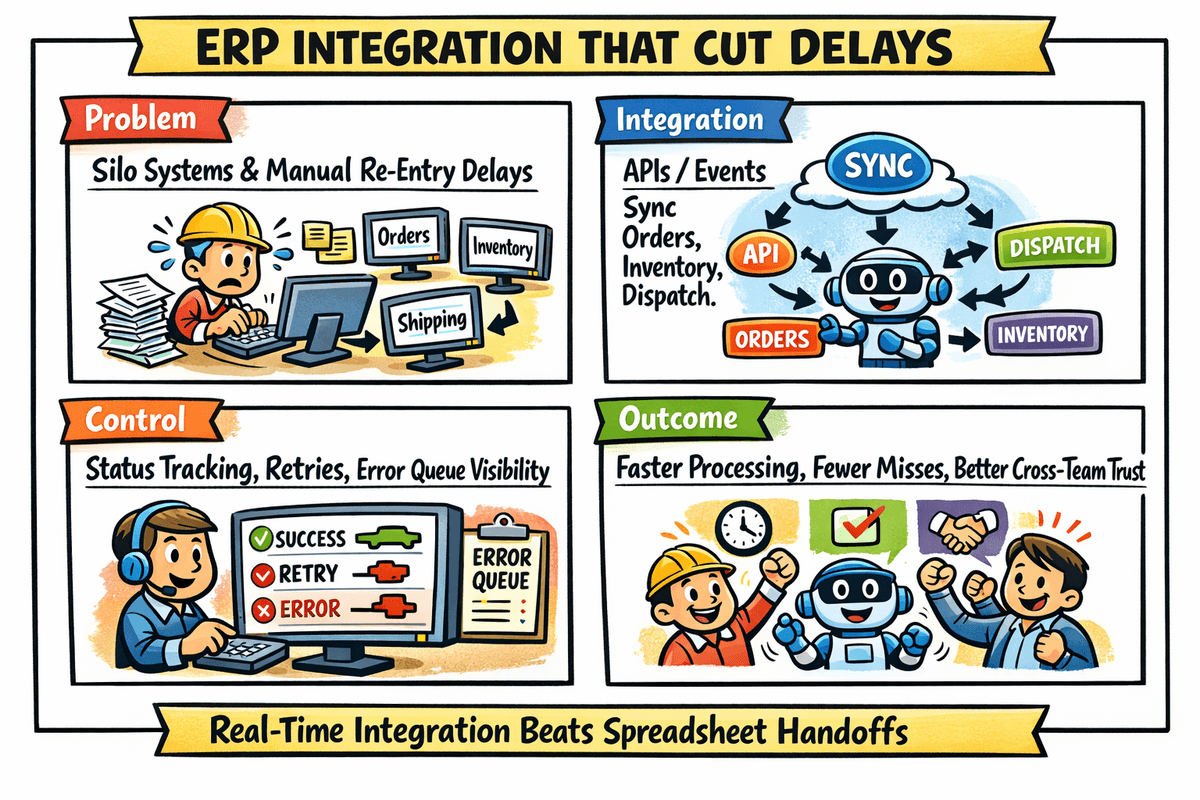
- Teams re-entered the same data in multiple systems.
- Timing mismatches caused downstream planning errors.
- Report generation required manual consolidation.
Objective
Build reliable, auditable integrations between operational modules and ERP boundaries while preserving each system’s ownership model.
Boundary Model We Enforced
- ERP: planning, finance, and enterprise transaction authority.
- MES: production execution, tracking, and operational state transitions.
- WMS: inventory authority, allocation, and physical movement control.
This boundary clarity reduced ownership confusion during incidents.
Approach
- Mapped master data ownership across systems.
- Defined contract-driven APIs for critical transactions.
- Added asynchronous updates for non-blocking flows.
- Implemented retry-safe connectors with explicit failure states.
- Enforced stable transaction IDs for dedupe-safe retries.
- Kept inventory source-of-truth in WMS while exposing MES request visibility.
No-API Constraint: How We Delivered Anyway
In one implementation, the ERP team committed to integration but declined to expose APIs.
To avoid project delay, we built a controlled RPA bridge using Puppeteer that mimicked operator actions in their portal with strict validation and traceability.
What we automated
- Pulled sales order data from the ERP portal into our system.
- Pulled purchase order and RMPO data for downstream planning.
- Pulled RM inspection reports and synchronized quality decisions.
- Submitted shop-floor tracking updates from our application back into ERP forms through the same automation flow.
Controls we added to keep it production-safe
- Deterministic run IDs and correlation IDs for every automated transaction.
- Input validation before form submission and reconciliation checks after submission.
- Retry and recovery paths for transient portal failures.
- Structured logging and alerting for failed posting windows.
Technical Blueprint
- API contracts documented and versioned.
- Event notifications for cross-system state changes.
- Centralized logging with transaction correlation IDs.
- Health and reconciliation checks for integration lanes.
- Request status model to isolate "intent created" vs "allocation confirmed" states.
Business Results
- Reduced duplicate data entry overhead.
- Lowered delay loops caused by integration uncertainty.
- Improved trust in operational and managerial reports.
- Created a reusable integration pattern for future modules.
- Completed ERP integration timelines even in API-denied environments.
Key Lesson for Architecture Teams
The most important decision was not a framework choice. It was ownership clarity. Once each layer had clear authority and deterministic contracts, incident response and scaling both improved.
Leadership Perspective
Integration work often looks invisible from outside, but it directly drives cycle time, decision quality, and cross-team trust.
Closing Thought
When integration is treated as a product capability instead of a one-time project, business agility compounds over time.
Executive Snapshot
Integration becomes strategic when each system has clear authority and every cross-system state change is traceable.
Data Re-entry
ReducedContract-driven integrations removed repeated manual updates.Delay Risk
LowerRetry-safe connectors improved reliability during transient failures.Reporting Trust
HigherCorrelation IDs improved reconciliation and audit confidence.Boundary Definition
ERP, MES, WMS ownership mapping
Teams aligned responsibility first so integrations could be designed for deterministic behavior.
Contract and Event Layer
API + async updates
Critical transactions moved through versioned contracts and event-based updates for resilience.
Reliability Controls
Idempotency and observability
Dedupe-safe retries, health checks, and trace IDs turned integration into an operationally safe capability.