Engineering Journal
Case Study: Multi-Currency Coal Trading ERP with RPA-Based Index Price Ingestion

Context
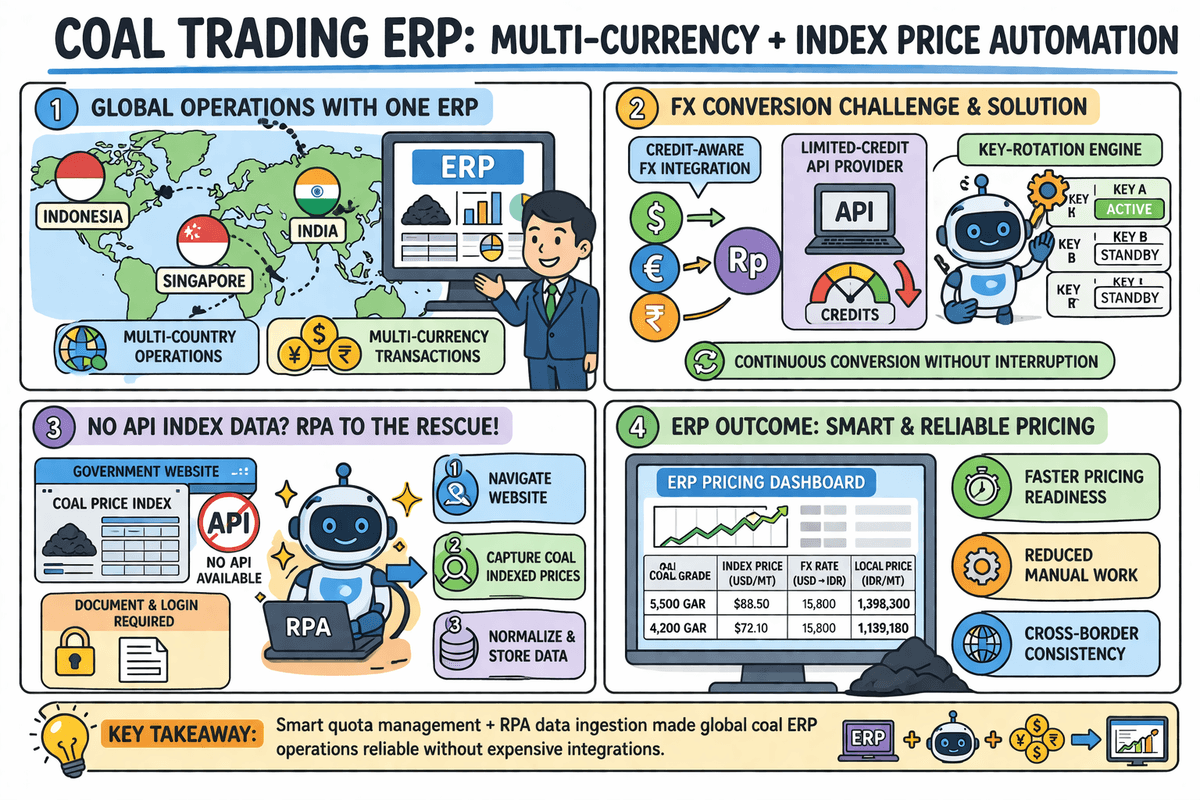
We developed an ERP platform for a coal-trading company operating across Indonesia, Singapore, and India. The same application had to support operations in multiple currencies and continuously ingest market-linked coal index prices used for trading decisions.
Business Challenges
1. Multi-Currency Operations Across Countries
The client operates cross-border workflows where procurement, contracts, logistics, and financial reporting involve different currency contexts. Currency conversion had to be accurate, stable, and available for day-to-day transaction flows.
2. Cost-Controlled FX Conversion Integration
Real-time currency conversion required external FX data providers. Paid plans at required call volume were expensive for the client's usage model.
We designed a credit-aware integration strategy using provider accounts and key pools to maintain continuity while staying within approved quota limits.
3. No API for Coal Index Prices
The client also needed indexed coal prices from government websites. Those sources did not expose public APIs and required multiple manual steps and document workflows to access data.
Without automation, teams had to repeatedly fetch and re-enter data manually, causing delays and inconsistency.
Objective
Build one ERP that can:
- support multi-country, multi-currency operations,
- provide reliable FX conversion in a cost-conscious model,
- and automatically ingest indexed coal prices from non-API government portals.
Solution Architecture
1. Multi-Currency ERP Core
We implemented multi-currency support across core modules so each transaction could retain:
- base currency,
- transaction currency,
- conversion rate metadata,
- and valuation context for downstream reporting.
This ensured pricing and commercial calculations remained consistent across regions.
2. Credit-Aware FX Integration Layer
Instead of depending on a single API key and risking outages on credit exhaustion, we built a quota-aware key management layer:
- monitored remaining credits,
- routed requests through active keys,
- rotated keys when quota thresholds were reached,
- and logged conversion source/rate context for traceability.
This delivered continuity while controlling recurring integration cost.
3. RPA for Government Index Price Capture
For coal index pricing, we built an RPA workflow that:
- navigates required government portal steps,
- retrieves required indexed pricing data,
- normalizes and validates values,
- pushes structured results into ERP pricing tables.
This replaced repetitive manual retrieval and improved freshness of market-linked inputs.
Workflow Summary
- ERP transaction requests FX conversion.
- FX integration checks active key quotas and selects valid provider key.
- Conversion data is fetched and stored with audit metadata.
- Scheduled RPA jobs collect index prices from government sources.
- Data is normalized and posted into ERP index-pricing module.
- Trading teams consume updated rates and index values in operational workflows.
Outcome
- One ERP platform successfully used across Indonesia, Singapore, and India.
- Stable multi-currency calculations in daily operations.
- Lower integration cost through credit-aware quota management.
- Automated coal index pricing ingestion despite no public APIs.
- Reduced manual dependency and faster pricing readiness for commercial teams.
Why This Implementation Stood Out
The project combined three hard realities in one system:
- cross-border currency complexity,
- cost pressure on third-party integrations,
- and non-API external data dependencies.
By combining ERP design, integration governance, and RPA automation, we delivered a practical production approach for a highly constrained trading environment.